Every year, at the end of November, people across the United States come together to celebrate one of the most cherished holidays: Thanksgiving. While many associate it with a feast of turkey and family gatherings, the holiday carries a deeper meaning that goes beyond food. Here, we explore five key aspects of Thanksgiving that shed light on its history, traditions, and enduring significance.
1. History and Origins
Thanksgiving traces its roots back to 1621 when the Pilgrims and Native Americans gathered to celebrate a successful harvest. This early celebration was about more than food – it was a time to express gratitude for community, survival, and abundance. Over the centuries, Thanksgiving evolved into an official national holiday, with the turkey becoming an iconic symbol, earning it the nickname “Turkey Day.”
“The First Thanksgiving 1621, oil on canvas by Jean Leon Gerome Ferris (1899).”
2. Traditions Across Generations
From simple harvest meals to grand parades, Thanksgiving has transformed while preserving its core values. Today, it is marked by events such as the Macy’s Thanksgiving Day Parade, traditional football games, and the Turkey Pardon at the White House. Despite societal changes, these traditions connect generations and reinforce a sense of togetherness and celebration.
3. The True Meaning of Thanksgiving
Thanksgiving is much more than food and family gatherings. It is a moment to pause, reflect, and express gratitude – for family, friends, community, and life’s blessings.
“Thanksgiving is about more than just a meal.”
Gratitude during Thanksgiving is not only a personal practice; studies suggest it can strengthen relationships, increase happiness, and improve overall well-being.
4. Iconic Foods and Their Significance
No Thanksgiving celebration is complete without classic dishes like turkey, stuffing, pumpkin pie, and cranberry sauce.
“Classic Thanksgiving dishes that bring flavor, history, and meaning to every holiday table.”
Each dish carries symbolic meaning: turkey represents abundance, pumpkin pie evokes the essence of autumn, and cranberry sauce adds a unique flavor that completes the festive meal. Together, they form a culinary tradition that spans centuries.
5. Thanksgiving Traditions Around the World
Although it is best known in the U.S., the spirit of Thanksgiving extends globally. Canada celebrates Thanksgiving in October, Liberia observes a similar holiday to honor freedom, and many other countries have customs to express gratitude and reflection. This shows that the value of thankfulness transcends borders and cultures.
“Thanksgiving is celebrated in many ways, reflecting the diverse cultures of the world.”
Conclusion
While Thanksgiving is deeply rooted in family and community, its message of gratitude has meaningful applications in the business world. Organizations that cultivate a culture of appreciation, recognizing employees, celebrating milestones and valuing partnerships, foster stronger engagement, loyalty and collaboration. Just as individuals pause to give thanks, companies can reflect on achievements and express gratitude, creating an environment where both people and business thrive. At Teaser Software, we embrace this philosophy by celebrating our team, valuing our clients and recognizing every milestone as part of our journey.
Have you ever come across the term “offshore” but weren’t quite sure what it really means? In this article, we will break down the concept of offshore, explore related terms like onshore and nearshore, and give practical examples to illustrate how it is applied in the real world.
1. What does Offshore mean?
The word “offshore” literally means “away from the shore” or “beyond the coast.” In business and finance, it refers to any operation, entity, or activity that is carried out in a foreign country, often for strategic, financial, or operational reasons.
Understanding the Term “Offshore”
For example, a company headquartered in the United States that registers a subsidiary in Singapore or the Cayman Islands is engaging in offshore activities. Offshore can also describe bank accounts, investments, or business structures set up outside one’s home country.
Key points to understand:
Not just abroad: Offshore is not simply “working abroad” but refers specifically to activities outside the home country for strategic purposes.
Purpose-driven: Common objectives include tax optimization, access to international markets, cost efficiency, regulatory benefits, and asset protection.
Widely used: Offshore structures and operations are common in international business, finance, legal planning, and investment management.
2. Related Concepts
Onshore Onshore refers to activities, investments, or entities within the same country as the main business or individual. Onshore operations typically involve fewer regulatory and communication challenges compared to offshore operations but may not offer the same financial or strategic advantages. For example, a U.S.-based company opening a branch in another U.S. state is conducting onshore activities.
Nearshore Nearshore refers to operations conducted in neighboring or nearby countries, usually with similar time zones or cultural backgrounds. Nearshoring aims to balance the benefits of offshore activities with easier collaboration and communication. For instance, a company in Germany hiring a software development team in Poland or Romania is using a nearshore model. Nearshore operations can provide cost savings while reducing coordination difficulties compared to distant offshore setups.
3. What are the benefits of offshore operations?
Cost Efficiency One of the main advantages of offshore activities is cost savings. Companies can reduce expenses on labor, operations, and infrastructure by leveraging countries with lower costs. For example, a European business managing part of its operations through a Singapore subsidiary can benefit from favorable tax regimes while keeping costs under control.
Access to Global Opportunities Offshore strategies allow businesses to expand internationally, access new markets, and diversify operations. A company may use offshore structures to sell products globally or invest in emerging markets that would otherwise be inaccessible.
Flexibility and Scalability Offshore arrangements provide flexibility to scale operations without being constrained by domestic resources. Companies can adjust their international presence according to demand, market opportunities, or strategic priorities.
Risk Management and Asset Protection Certain offshore structures offer legal and financial protections. For instance, offshore companies or accounts can safeguard assets, separate liabilities, and optimize tax planning, while remaining compliant with international regulations.
Strategic Focus By moving non-core operations offshore, businesses can focus on core activities in their home country, such as innovation, marketing, and strategic development. This approach helps companies remain competitive while leveraging global efficiencies.
Businesses use offshore to save, expand, and stay flexible.
4. What are the challenges of offshore activities?
Regulatory and Legal Complexity Operating offshore requires careful attention to local laws, international regulations, and compliance standards. Failure to comply can lead to penalties or legal complications.
Communication and Coordination Different time zones, languages, and cultures may create coordination challenges. Ensuring effective communication is crucial to avoid misunderstandings and delays.
Risk of Mismanagement Without proper oversight, offshore operations may face performance inconsistencies or misalignment with corporate goals. Regular monitoring and governance are essential.
Political and Economic Risks Changes in political policies, tax laws, or economic stability in the offshore country can affect operations or investments. Companies must evaluate country-specific risks before committing.
Integration and Transparency Offshore structures can sometimes create distance between management and operations, leading to a lack of transparency. Establishing clear reporting lines, audits, and governance policies can mitigate this challenge.
Managing offshore operations involves legal, political, and communication challenges.
5. Practical Applications of Offshore
Offshore activities are commonly applied in the following areas:
Company Formation: Many businesses establish offshore entities in countries with favorable regulations or tax structures, such as Singapore, Hong Kong, or the Cayman Islands.
Banking and Finance: Offshore accounts and investment vehicles are used for asset protection, tax planning, and international transactions.
Professional Services: Companies may perform offshore activities in accounting, legal services, or consulting through foreign branches or partners.
Trade and Operations: Global supply chains often involve offshore production, procurement, or service operations to optimize costs and access global talent.
For example, a U.S.-based entrepreneur may create an offshore company in Singapore to manage international sales while benefiting from Singapore’s business-friendly tax regime. Meanwhile, a European company might maintain nearshore customer support in Poland for smoother communication while keeping development teams offshore in Asia for cost efficiency.
6. How Offshore Companies Work
Offshore companies are legal entities registered in a foreign country, often chosen for favorable tax, business, or regulatory conditions. They allow businesses to manage assets, investments, or operations internationally while benefiting from local incentives like lower taxes or simpler reporting.
Typically, an offshore company is overseen by a local agent or director, while strategic decisions are coordinated remotely by the main stakeholders. Banking, accounting, and compliance are handled according to the offshore jurisdiction’s rules.
Companies leverage offshore entities for global management and efficiency.
For example, a U.S. entrepreneur may register a company in Singapore to manage international clients and optimize taxes while keeping the core team in the U.S. Similarly, a European investor could use a Cayman Islands holding company to manage global investments efficiently. Understanding these operations helps businesses navigate regulations and optimize global resources.
Conclusion
Offshore is more than a term; it represents a strategic approach to global business and investment. It offers cost efficiency, international market access, scalability, and asset protection, but also comes with challenges like regulatory compliance, communication barriers, and political risks. Understanding offshore and related concepts such as onshore and nearshore empowers businesses and investors to make informed decisions and leverage international opportunities responsibly. Whether for company formation, investment, or global operations, offshore strategies remain a powerful tool in today’s interconnected world.
If you’re looking to build an Offshore Development Center in Vietnam, then Teaser Software is truly the partner you can rely on. We’ve helped many international clients — from startups to enterprise-level companies — set up full offshore engineering teams here in Hanoi. What makes us different is our commitment to transparency, communication, and long-term partnership. We don’t just provide developers — we build a dedicated extension of your company, fully aligned with your vision and culture.
Whether you need to scale fast, expand your capabilities, or establish a long-term tech presence in Southeast Asia, Teaser Software provides the structure, the people, and the support to make it happen.
So if you’re exploring the idea of building your own ODC in Vietnam — let’s connect. Our team will walk you through everything you need to know and help you build the perfect offshore team for your business.
The decision between React Native vs Flutter in 2025 is no longer about “which one works” — both frameworks are proven, mature, and production-ready. Instead, the choice depends on your team composition, product vision, and long-term roadmap.
If you need speed-to-market and have existing JavaScript/React talent, React Native is the pragmatic choice. With its Bridgeless New Architecture and JSI, plus TypeScript now default in version 0.76, React Native has smoothed out many of its historical performance gaps.
If you’re building a pixel-perfect, consistent UI across platforms, Flutter leads the way. Its Impeller renderer and Material 3 integration deliver high-fidelity experiences that look identical on iOS, Android, and beyond.
For complex, animation-heavy enterprise apps, Flutter’s canvas-based rendering gives you tighter control and performance stability.
For teams needing reuse across web, desktop, and mobile, React Native integrates more naturally with existing JavaScript/TypeScript stacks.
Still not sure? Teaser Software offers a free 30-minute framework assessment tailored to your product’s needs.
What They Are
Before diving into architecture and performance, let’s quickly clarify what these frameworks actually are in 2025
What Is React Native (2025)?
Originally created by Meta, React Native is a JavaScript-based framework for building native mobile apps that look and feel like they were coded separately for iOS and Android.
In 2025, the framework has matured massively:
The Bridgeless Architecture and JSI allow JavaScript to communicate directly with native modules — no more lag from the old bridge.
TypeScript is now standard, giving apps better type safety and predictability.
The tooling ecosystem (Expo SDK 51+, Flipper, Hermes 2) makes development faster, debugging easier, and CI/CD smoother.
Big tech players still trust it — Instagram, Walmart, Coinbase, and Uber Eats run core experiences on React Native. That proves one thing: React Native is battle-tested at scale and ready for the enterprise age.
What is Flutter?
Flutter, developed by Google, is a UI toolkit that renders everything on its own canvas rather than using native components. Its new Impeller renderer offers smoother GPU performance and battery efficiency, and its Material 3 integration gives developers a consistent look across platforms.It’s great for design-system-heavy apps that must look identical everywhere. However, its approach means you’re decoupled from native platform evolution — each iOS or Android update requires manual catch-up work in Flutter.
Architecture & Rendering — The Fundamental Split
This is where React Native pulls ahead in 2025.
Flutter renders everything on its own canvas. That’s why its UI looks identical on every device — but also why it can feel out of sync with the latest iOS or Android visual changes. Every system update means extra engineering effort to maintain parity and accessibility.
React Native, on the other hand, embraces native rendering. It connects JavaScript logic directly to OS-level components via JSI, so your app automatically inherits new native animations, transitions, and accessibility features as they arrive.
That means React Native apps age better. They stay visually current and compliant without constant framework-level maintenance.
Aspect
React Native (2025)
Flutter (2025)
Rendering
Uses real native components via JSI (Bridgeless)
Renders on its own canvas
UI Updates
Auto-syncs with OS evolution
Manual updates for new UI patterns
Accessibility
Inherits native APIs
Must re-implement each change
Look & Feel
Platform-authentic UI
Pixel-perfect uniform UI
For enterprises operating in regulated sectors (fintech, healthcare, public services), React Native’s native parity also simplifies compliance with ADA and WCAG accessibility standards.
Flutter gives you control over every pixel. React Native gives you control over your future maintenance and native evolution — and that’s the control that actually saves money long-term.
Performance in 2025 — Bridgeless React Native Levels the Playing Field
Performance has always been the headline debate in “Flutter vs React Native.” But in 2025, that story has changed — dramatically.
React Native’s Bridgeless Architecture, combined with JSI (JavaScript Interface), has closed the historical gap that once gave Flutter a lead. The result? Native-level responsiveness, faster cold starts, and smoother UI threads — without rewriting everything in Dart.
Benchmarks from enterprise deployments show:
Up to 40% lower latency on UI-heavy interactions.
Fewer dropped frames during animations or transitions.
Hermes 2 engine improving memory efficiency and runtime stability.
Concurrent rendering enabling React Native to better utilize multi-core CPUs on modern devices.
In other words: React Native is no longer “almost native.” It is native — just with a JavaScript brain.
Flutter’s Impeller still offers top-notch GPU performance and excels in graphics-heavy apps like automotive dashboards or 3D-rich visualizations. But for most mobile apps — social, e-commerce, finance, delivery — React Native’s new runtime achieves near-identical FPS and smoother business logic execution.
React Native also integrates seamlessly with native modules, letting teams optimize only where it matters instead of maintaining an entire custom rendering pipeline.
Flutter wins in niche, graphics-heavy use cases. But for 90% of modern mobile apps, React Native’s Bridgeless performance is more than enough — and easier to scale, debug, and maintain.
Ecosystem, Packages & Community Health
Both frameworks are thriving — but the DNA of their ecosystems reveals who’s thinking long-term.
React Native’s npm Universe — Breadth, Depth, and Maturity
React Native rides on the back of npm, the largest open-source registry in the world. That means:
You can find packages for anything — from analytics SDKs to Stripe payments, Maps, and Firebase.
There’s deep integration with React, TypeScript, and Next.js ecosystems.
The community includes tens of thousands of contributors, corporate sponsors, and maintainers from Meta, Microsoft, Shopify, and beyond.
While package quality can vary, established engineering teams mitigate that with SCA (Software Composition Analysis) and internal wrappers — a small trade-off for the world’s most flexible codebase ecosystem.
Flutter’s pub.dev has improved rapidly, and its official Google plugins are top-tier. However, the ecosystem remains more centralized — great for stability, but slower for innovation. React Native’s open nature, in contrast, ensures continuous evolution, new integrations, and enterprise-level tooling.
That’s why more CI/CD platforms, monitoring tools, and A/B testing suites support React Native first.
If your product roadmap depends on rapid integration, third-party SDKs, and DevOps flexibility — React Native’s ecosystem gives you more freedom to move, faster.
Talent Availability & Hiring Reality — The Business Advantage of React Native
In cross-platform development, your framework is only as good as the people who can build with it.
And here’s where React Native dominates.
The Talent Pool
React Native taps into the largest developer base in the world — JavaScript and React. That means:
Easier hiring and onboarding.
Lower long-term salary pressure.
Faster access to experienced contractors and outsourcing partners.
There are hundreds of thousands of engineers who can move from React web apps to React Native mobile development with minimal upskilling. This reduces risk, accelerates MVPs, and allows internal teams to grow organically instead of depending solely on niche hires.
Flutter, by contrast, relies on Dart, a capable but far less common language. While Flutter developers are skilled and in demand, the limited pool increases hiring lead times and salary costs — especially in emerging markets.
Outsourcing Perspective
At Teaser Software, we’ve seen this dynamic play out firsthand. Companies that choose React Native benefit from:
Larger recruitment pipelines.
Quicker ramp-up times.
Easier collaboration with web teams sharing design systems and APIs.
Our dedicated pods (PM, Tech Lead, Developers, QA, DevOps) help clients bootstrap React Native projects while mentoring internal engineers — a hybrid model that balances speed and sustainability.
Outsourcing Tip: Outsource to accelerate, not to replace. Teaser’s React Native teams integrate with your workflow, enabling you to retain product knowledge while scaling faster.
Flutter talent is growing, but React Native talent is already everywhere. For CTOs, that means faster delivery, lower risk, and smoother scaling — critical advantages in competitive markets.
Use Cases — Real-World Clarity (Not Generic Advice)
By 2025, both frameworks are reliable, but they shine in different arenas. Let’s move beyond vague comparisons and focus on where React Native truly delivers value.
Choose React Native if you…
Already have a React web app or JS-based stack. You’ll reuse your code, your state management logic, and even parts of your UI components.
Need speed-to-market for MVPs or new product launches. React Native’s npm ecosystem, Expo CLI, and over-the-air updates make deployment lightning-fast.
Care about OS consistency and compliance. Because React Native uses native components, your app automatically stays aligned with evolving iOS/Android visual standards and accessibility guidelines.
Want to scale across platforms — web, desktop, and mobile — without fragmentation.
Choose Flutter if you…
Are building animation-heavy or design-driven products that must look identical across all screens (e.g., media, gaming, custom dashboards).
Want a fully controlled design system, independent of platform look-and-feel.
Can invest in specialized Dart talent for deeper UI optimization.
If your app’s core value lies in user experience consistency — Flutter is strong. If your business value lies in scaling, integrating, and shipping fast with real-world talent — React Native is the clear winner.
Cost, Time-to-Market, and ROI
From a business lens, React Native consistently delivers a better ROI due to its ecosystem and workforce advantages.
Shared skillsets = lower cost. Your existing React or JavaScript team can pivot to mobile development without rebuilding from scratch.
Reduced time-to-market. React Native’s build pipelines (EAS, Expo, Fastlane) and npm libraries eliminate weeks of setup and integration time.
Long-term savings. Native updates and accessibility improvements roll in automatically — reducing ongoing maintenance costs.
Flutter’s strength is in visual perfection, but that comes with trade-offs:
You’ll often need more senior engineers to maintain performance consistency across devices.
Each new OS release can require patching or manual re-theming to stay current.
Both frameworks save roughly 30–40% in initial cost versus fully native development — but React Native’s operational flexibility compounds savings across the product’s lifecycle.
Flutter may win early beauty contests. React Native wins in scalability, team economics, and lifecycle cost efficiency — the metrics that actually matter for CTOs and founders.
Risks & Trade-offs — The Reality Check
Every framework has trade-offs, and choosing React Native or Flutter should depend on your roadmap maturity.
Risk Area
React Native
Flutter
OS parity
Updates instantly with iOS/Android
Requires manual UI sync
Talent availability
Large, global, cross-functional
Smaller, higher-cost pool
Rendering stability
Native rendering, adaptive
Canvas rendering, stable but isolated
Enterprise tooling
Deep ecosystem (EAS, Expo, App Center)
Growing, Google-driven
Migration risk
Backed by Meta, broad contributor base
Dependent on Google roadmap
Key insight: Flutter’s roadmap depends heavily on Google’s priorities, which can shift (as seen with Angular, Fuchsia, and other projects). React Native’s evolution, in contrast, is community-driven — supported by Meta, Microsoft, and a massive open-source ecosystem. That gives it staying power far beyond corporate sponsorship.
Outsourcing with Teaser Software — Your Shortcut to Clarity
At Teaser Software, we’ve helped startups and enterprises make the right call between Flutter and React Native — and deliver real results. Our discovery sprint model gives you clarity before you commit:
Discovery Sprint (2–3 weeks)
Assess your business and technical needs.
Run side-by-side PoC (Proof of Concept) builds on React Native and Flutter.
Benchmark UI performance, integration speed, and code reusability.
Delivery Model
Dedicated pods with PM, Tech Lead, Developers, QA, and DevOps.
Knowledge transfer built in — so your internal team learns alongside ours.
SLAs & KPIs
Cycle time and crash-free session targets.
App size & performance budgets.
Continuous feedback loops for measurable improvement.
Conclusion — Why React Native Wins the 2025 Race
Both Flutter and React Native have matured into powerful frameworks. But when you factor in:
Performance parity (thanks to Bridgeless + JSI),
Broader talent availability,
Easier maintenance and native evolution,
And a thriving ecosystem that scales across the web and mobile,
…it’s clear why React Native stands as the strategic, future-proof choice for 2025 and beyond.
If your app demands speed, flexibility, and team scalability → React Native is your pragmatic winner. If your app demands custom animations and perfect visual control → Flutter is still a strong alternative.
Ultimately, the best decision comes down to context — and that’s where Teaser Software can help you decide with confidence.
Ready to decide? Book your free framework consultation with Teaser Software today. Our cross-platform experts will help you align technology, timeline, and team to build the right app the first time.
In today’s fast-paced software industry, Agile development has become the go-to methodology for delivering high-quality products efficiently. However, maintaining an Agile workflow requires skilled resources, rapid iterations, and seamless collaboration—challenges that many businesses struggle with due to limited in-house expertise, budget constraints, or scalability concerns.
IT Outsourcing Control
This is where IT outsourcing plays a crucial role. By leveraging external expertise, companies can access a global talent pool, accelerate development cycles, and optimize costs without compromising quality. Outsourcing partners can integrate seamlessly into Agile teams, providing specialized skills, round-the-clock development support, and the flexibility needed to scale operations up or down as project demands shift. Additionally, outsourcing allows businesses to focus on core competencies while delegating complex technical tasks to experienced professionals, ultimately enhancing productivity and innovation.
In this article, we will explore how IT outsourcing complements Agile development, the benefits it brings to software teams, and best practices for ensuring successful collaboration between in-house and outsourced teams.
The Importance of Choosing the Right IT Outsourcing Partner
Selecting the right outsourcing partner is crucial for successfully integrating IT outsourcing into Agile development. A well-matched provider ensures seamless collaboration, maintains development speed, and upholds quality standards. When evaluating potential outsourcing partners, businesses should consider the following key criteria:
Expertise in Agile Development
Agile outsourcing requires a deep understanding of Scrum, Kanban, SAFe, and Lean methodologies. The right partner should have a proven track record of working within Agile frameworks, demonstrating their ability to adapt to rapid iterations, continuous delivery, and cross-functional team collaboration. Look for partners who have successfully executed Agile projects across different industries and can provide case studies or client references.
Transparency in Communication
Effective Agile collaboration depends on clear, real-time communication. An ideal outsourcing partner should prioritize transparency, using tools like Jira, Trello, Slack, or Microsoft Teams to ensure smooth information flow. They should actively participate in daily stand-ups, sprint planning, and retrospectives, ensuring that both in-house and outsourced teams stay aligned. Additionally, establishing clear KPIs and regular reporting mechanisms helps maintain visibility into project progress and performance.
Compliance with Security and Legal Standards
Outsourcing involves sharing sensitive business data, making security and compliance essential. The right partner must follow industry-standard security protocols and comply with regulations such as ISO 27001, GDPR, HIPAA, and SOC 2. NDAs (Non-Disclosure Agreements), robust access control policies, and encrypted communication channels should be in place to safeguard intellectual property and prevent data breaches. Regular security audits and adherence to compliance best practices further enhance trust and risk mitigation.
Flexibility in Team Scaling
Agile projects often require dynamic team structures that adjust based on project needs. A reliable outsourcing partner should offer scalable solutions, allowing businesses to quickly expand or reduce team size without long-term commitments. Whether scaling up for a product launch or optimizing resources during a maintenance phase, flexibility is key to ensuring efficiency and cost-effectiveness.
By carefully selecting an outsourcing partner that meets these criteria, companies can enhance their Agile development capabilities, accelerate product delivery, and maintain high-quality software solutions while optimizing costs.
How IT Outsourcing Supports Agile Development
In an Agile environment, where speed, adaptability, and efficiency are paramount, IT outsourcing provides a strategic advantage that enables companies to navigate challenges while maintaining high development standards. By leveraging external expertise, businesses can enhance their Agile workflows in several key ways.
Access to Specialized Expertise
Agile development thrives on cross-functional teams with diverse skill sets, from front-end and back-end development to quality assurance, DevOps, and cloud engineering. However, assembling such a team in-house can be time-consuming and costly. Outsourcing allows companies to tap into a vast global talent pool of seasoned professionals who possess specialized knowledge in cutting-edge technologies, frameworks, and Agile best practices. This ensures that businesses can rapidly onboard experts with the precise skill sets needed for each phase of development, accelerating project execution without the delays associated with recruitment and training.
Scalability & Flexibility
One of the defining characteristics of Agile is its iterative approach, where project requirements evolve based on continuous feedback. This necessitates a dynamic team structure that can expand or contract depending on workload fluctuations. IT outsourcing provides the flexibility to scale resources up or down effortlessly, ensuring that companies can meet project demands without overcommitting to long-term staffing costs. Whether ramping up a team for a critical product launch or streamlining operations during a maintenance phase, outsourcing ensures optimal resource utilization while maintaining efficiency.
Faster Development Cycles
Agile methodologies emphasize rapid iterations and continuous delivery, both of which require a development pipeline that operates seamlessly. Outsourcing to global teams, particularly those in different time zones, enables 24/7 development cycles, where work progresses even outside of standard business hours. This “follow-the-sun” approach significantly reduces turnaround times, accelerates sprint completion, and ensures that new features or updates are delivered to market faster. Additionally, outsourcing partners often bring structured workflows and automation expertise that further streamline development and deployment processes.
Cost Optimization
Building and maintaining an in-house Agile team demands substantial financial investment in hiring, training, infrastructure, and employee retention. By outsourcing, companies can eliminate many of these fixed costs and instead operate on a more flexible, pay-as-you-go model. This allows businesses to allocate financial resources toward core product innovation, customer acquisition, and competitive differentiation rather than getting bogged down in operational expenses. Furthermore, outsourcing to regions with favorable labor costs provides an additional layer of financial efficiency without compromising quality.
Improved Focus on Core Business Goals
By delegating development, testing, and infrastructure management to a trusted outsourcing partner, internal teams can concentrate on strategic business objectives such as market expansion, customer experience enhancement, and long-term product vision. This division of labor ensures that leadership and key stakeholders are not overwhelmed with technical execution but instead can direct their efforts toward growth, innovation, and sustaining a competitive edge. Additionally, outsourcing partners often bring industry insights and best practices that contribute to overall business strategy, fostering continuous improvement and innovation.
Ultimately, IT outsourcing serves as a powerful enabler for Agile development, providing the expertise, scalability, speed, cost-efficiency, and focus necessary to drive success in a competitive digital landscape.
Challenges & Solutions in Agile IT Outsourcing
While IT outsourcing brings significant advantages to Agile development, it also presents unique challenges that, if not managed effectively, can hinder productivity and collaboration. Below, we explore some common challenges and practical solutions to ensure a seamless Agile outsourcing experience.
Communication Gaps Due to Time Zones and Cultural Differences
One of the most common obstacles in Agile outsourcing is communication friction caused by time zone differences and varying cultural workstyles. Misalignment in working hours can lead to delays in feedback loops, while differences in work culture, expectations, and language proficiency may affect collaboration and decision-making.
Solution:
To bridge these gaps, organizations should establish clear communication protocols and leverage Agile collaboration tools such as Slack, Microsoft Teams, Jira, and Confluence for real-time updates, task tracking, and asynchronous communication. Additionally, defining overlapping working hours, scheduling regular video meetings, and fostering a culture of transparency can enhance collaboration. Investing in cross-cultural training and setting expectations for responsiveness and work ethics can also improve team dynamics.
Lack of Control Over Outsourced Teams
Agile teams rely on continuous collaboration, rapid iterations, and shared ownership of tasks. However, when working with an outsourced team, companies may feel a lack of control over project progress, adherence to Agile principles, or overall accountability.
Solution:
To maintain alignment, businesses should establish strong Agile governance by implementing daily stand-ups, sprint planning sessions, retrospectives, and regular progress reviews. Clear key performance indicators (KPIs) and service-level agreements (SLAs) should be set to track performance. Additionally, assigning a dedicated Agile coach or project manager to oversee outsourced teams and facilitate seamless integration with in-house teams can ensure greater visibility and accountability.
Security and Data Privacy Concerns
Handling sensitive business data and intellectual property while outsourcing development raises concerns about security breaches, data leaks, and regulatory compliance. Without proper safeguards, outsourcing can pose risks to confidentiality and business integrity.
Solution:
To mitigate security risks, companies should partner with outsourcing vendors who adhere to industry-leading security standards such as ISO 27001, GDPR, HIPAA, or SOC 2 compliance. Implementing non-disclosure agreements (NDAs), role-based access controls (RBAC), secure VPNs, and end-to-end encryption can further protect sensitive information. Additionally, conducting regular security audits and providing cybersecurity training for both in-house and outsourced teams can strengthen overall data protection.
By proactively addressing these challenges with structured solutions, companies can successfully integrate IT outsourcing into Agile workflows, ensuring efficiency, security, and seamless collaboration across distributed teams.
Challenge
Solution
Communication gaps due to time zones and cultural differences
Use Agile collaboration tools like Slack, Jira, and Confluence for real-time updates
Lack of control over outsourced teams
Implement daily stand-ups, sprint planning, and retrospectives to maintain alignment
Security and data privacy concerns
Work with trusted outsourcing partners who follow industry best practices in security and compliance
Why Choose TEASER for Agile IT Outsourcing?
TEASER is a trusted IT outsourcing partner, providing Agile-centric teams, rapid scalability, and seamless integration into your development process. Our expertise in Scrum, Kanban, SAFe, DevOps, and CI/CD ensures faster, high-quality software delivery.
Agile-Centric Teams & Rapid Scaling
Our dedicated teams are trained in Agile best practices, allowing for smooth collaboration and quick adaptation to evolving project needs. With on-demand scalability, you can easily adjust team size without long-term commitments.
DevOps & CI/CD Integration
We streamline Agile workflows with automated testing, CI/CD pipelines, and DevOps practices, enabling faster releases and improved software quality.
Transparent Collaboration & Security
TEASER ensures real-time communication through tools like Jira, Trello, and Slack, keeping teams aligned. We prioritize data security with compliance to ISO 27001, GDPR, and SOC 2, safeguarding your intellectual property.
Get Started with TEASER
Enhance your Agile development with cost-effective, scalable, and high-quality outsourcing. Contact us today to accelerate your projects!
Outsourcing provides businesses with access to specialized expertise, reduces operational costs, and accelerates product development. However, while outsourcing offers numerous benefits, it also introduces significant risks, particularly regarding intellectual property (IP) protection.
Without proper safeguards, companies may face challenges such as data breaches, unauthorized use of proprietary assets, or even loss of exclusive rights to innovations. Sensitive information, trade secrets, patents, copyrights, and trademarks are all at risk if not adequately protected.
To mitigate these risks, businesses must implement robust legal agreements, enforce strict security protocols, and collaborate with trusted partners who adhere to industry best practices in IP protection. By taking proactive steps, organizations can safeguard their intellectual assets while leveraging the advantages of outsourcing.
Understanding Intellectual Property Risks in Outsourcing
Outsourcing offers efficiency and cost savings, but it also presents significant intellectual property (IP) risks that can jeopardize confidential data, competitive advantage, and business sustainability. Without proper safeguards, companies may face unauthorized data use, legal disputes, or even loss of proprietary assets.
A key concern is the unauthorized use or disclosure of sensitive information. Weak confidentiality agreements or outsourcing to jurisdictions with poor IP enforcement can lead to data leaks, allowing competitors access to critical business insights. Strong Non-Disclosure Agreements (NDAs) and well-defined contractual terms are essential to prevent misuse.
Another major risk is losing ownership of intellectual property. Vague contracts can create disputes over software code, patents, or product designs. Businesses must clearly define ownership rights in contracts, ensuring they retain full control over all deliverables. Additionally, copyright infringement can arise if vendors reuse proprietary code or integrate unlicensed materials, leading to legal and financial consequences. Conducting thorough vendor audits and ensuring compliance with copyright laws help mitigate this risk.
Security vulnerabilities further compound IP risks. Weak cybersecurity measures at an outsourcing provider can expose sensitive data to hacking, insider threats, or data breaches. Enforcing strict security protocols, including encryption, access controls, and compliance with international security standards (e.g., ISO 27001), is crucial for safeguarding intellectual assets.
By proactively addressing these risks with strong legal agreements, rigorous vendor screening, and robust security measures, businesses can maximize outsourcing benefits while protecting their most valuable intellectual property.
Establishing Clear Ownership Through Contracts
A well-structured outsourcing contract is the foundation of intellectual property protection. The contract must explicitly outline ownership of all source code, patents, trademarks, and any other proprietary assets developed during the partnership. A critical aspect of contract drafting is including non-compete clauses to prevent vendors from leveraging your intellectual property for competitors or launching similar products on their own. Additionally, termination clauses should specify how sensitive data will be returned or destroyed at the conclusion of the contract.
Ensuring legal clarity in outsourcing contracts reduces ambiguity and safeguards businesses from potential exploitation. Companies should collaborate with experienced legal professionals to draft comprehensive agreements that leave no room for misinterpretation. Investing in legal due diligence upfront can prevent costly litigation and protect long-term business interests.
A well-structured outsourcing contract is the cornerstone of intellectual property protection, serving as the legal framework that defines ownership rights and prevents potential disputes. Without precise contractual language, businesses risk losing control over proprietary assets, including source code, patents, trademarks, trade secrets, and other intellectual property developed during the collaboration.
To ensure airtight ownership provisions, contracts must explicitly state that all work produced by the outsourcing partner is the sole property of the hiring company. This is especially critical in software development, where ambiguities regarding authorship and licensing can lead to costly legal battles. The inclusion of “work-for-hire” clauses reinforces this by making it clear that any intellectual property created under the contract is automatically assigned to the client, eliminating any claims of shared or residual ownership by the vendor.
Beyond ownership, contracts should also incorporate robust non-compete and non-solicitation clauses. These provisions prevent vendors from repurposing proprietary knowledge, algorithms, or trade secrets for competitors or their own ventures. Without such safeguards, an outsourcing partner could leverage industry insights gained from the project to develop competing products or offer similar services to rival businesses, undermining the competitive advantage of the original IP owner.
Termination clauses play an equally crucial role in protecting intellectual property. The contract should clearly specify the procedures for handling sensitive data, ensuring that upon project completion or contract termination, all proprietary information is either securely returned or permanently destroyed. Without well-defined exit terms, businesses risk losing control over their confidential data, which may remain on the vendor’s servers or be reused in unauthorized ways.
Given the complexity of IP law and the risks associated with outsourcing, companies should engage experienced legal professionals to draft and review contracts. A carefully crafted agreement reduces ambiguity, strengthens enforceability, and minimizes the likelihood of disputes. Investing in legal due diligence at the outset not only safeguards intellectual assets but also ensures long-term business sustainability by preventing potential exploitation and costly litigation down the road.
Strengthening Security with Controlled Access Measures
When outsourcing, minimizing data exposure is critical to protecting intellectual property and maintaining business integrity. Without robust security controls, sensitive information can be vulnerable to unauthorized access, insider threats, and external cyberattacks. Implementing well-structured access management strategies helps mitigate these risks by ensuring that only authorized personnel can interact with critical data and systems.
A fundamental approach to controlled access is Role-Based Access Control (RBAC), which restricts system access based on an individual’s job function. By granting employees and outsourcing partners only the minimum level of access necessary for their tasks, businesses can reduce the risk of accidental data leaks or intentional misuse. This principle, known as the principle of least privilege (PoLP), ensures that confidential data is not needlessly exposed to individuals who do not require it.
Continuous monitoring of data access logs is equally important in maintaining security. Detailed access logs allow businesses to track who is interacting with sensitive files, when, and for what purpose. Proactive monitoring helps detect anomalies, such as unauthorized login attempts or unusual data transfer patterns, enabling organizations to respond swiftly to potential security breaches.
Beyond access controls, encryption plays a vital role in safeguarding proprietary data. Encrypting information both in transit and at rest ensures that even if data is intercepted, it remains unreadable without the appropriate decryption keys. Secure encryption protocols, such as AES-256 and TLS (Transport Layer Security), are industry standards that provide strong protection against cyber threats.
Multi-factor authentication (MFA) adds another layer of defense by requiring users to verify their identity through multiple authentication methods, such as passwords combined with biometric scans or one-time passcodes. This extra security step significantly reduces the risk of unauthorized access, especially when outsourcing partners are working remotely or across different geographical locations.
Secure communication channels are also essential for protecting sensitive discussions and file exchanges between in-house teams and outsourcing vendors. Utilizing encrypted messaging applications, Virtual Private Networks (VPNs), and secure collaboration platforms ensures that confidential information is not intercepted during transmission. Without these safeguards, unprotected communication channels can become entry points for cybercriminals looking to exploit security weaknesses.
A security-first mindset must be ingrained in an organization’s outsourcing strategy. By implementing strict access controls, continuously monitoring data interactions, enforcing encryption standards, and securing communication channels, businesses can significantly reduce the risks associated with external partnerships. In an era where cyber threats are increasingly sophisticated, a proactive approach to security is essential to preserving intellectual property and maintaining trust in outsourcing relationships.
Selecting Vendors with Strong Security and Compliance Policies
Choosing the right outsourcing partner is fundamental to ensuring intellectual property security. Businesses should conduct thorough due diligence before engaging with vendors, assessing their security protocols, compliance with international standards, and history of data protection. Certifications such as ISO 27001 and compliance with GDPR and HIPAA regulations are strong indicators of a vendor’s commitment to security.
Transparency in how vendors manage confidential data is equally crucial. Organizations should request detailed documentation on internal policies, employee background checks, and encryption practices. Regular security audits should be mandated to ensure the vendor continues to meet evolving security requirements.
By collaborating with vendors who prioritize data protection, businesses can establish long-term, trust-based outsourcing relationships.
Continuous Auditing and Monitoring of Outsourcing Arrangements
Regular security audits are essential for maintaining a secure outsourcing partnership. Conducting frequent assessments allows businesses to identify vulnerabilities and address them before they lead to security breaches. Companies should implement automated monitoring tools that provide real-time insights into project progress, data access patterns, and potential anomalies.
Beyond technical monitoring, businesses must ensure that outsourced teams adhere to ethical software development practices. Regular code reviews help verify compliance with licensing agreements and prevent the unintentional use of copyrighted materials. By fostering a culture of accountability, companies can reduce risks associated with outsourcing intellectual property-sensitive projects.
Case Study: How a Startup Safeguarded Its IP with TEASER
A U.S.-based startup sought to develop a proprietary mobile app but had concerns about intellectual property security when outsourcing. By partnering with TEASER, the startup implemented a secure development environment that included restricted access to proprietary information, encrypted communication channels, and legally binding agreements ensuring complete IP ownership.
Throughout the development process, TEASER provided real-time monitoring and periodic security audits, reinforcing confidence in the partnership. As a result, the startup successfully launched its product while maintaining full control over its intellectual property.
Why TEASER is the Best Choice for Intellectual Property Protection in Outsourcing
TEASER is committed to protecting clients’ intellectual property with legally binding agreements, rigorous security protocols, and a transparent development process. Our contracts ensure 100% IP ownership, leaving no room for ambiguity regarding proprietary rights.
We adhere to internationally recognized security frameworks. Our encrypted communication and multi-factor authentication measures further reinforce security.
TEASER also provides clients with full visibility into project progress through real-time monitoring dashboards. Regular security audits help identify and mitigate risks proactively. Additionally, we build dedicated teams tailored to each client’s needs, ensuring restricted access to sensitive information and preventing unauthorized third-party sharing.
Secure Your Intellectual Property with TEASER Today!
Outsourcing should be a strategic advantage, not a security risk. With TEASER as your trusted IT outsourcing partner, you can innovate confidently while safeguarding your intellectual property.
📩 Contact us today to learn how we can help protect your business while delivering world-class outsourcing solutions!
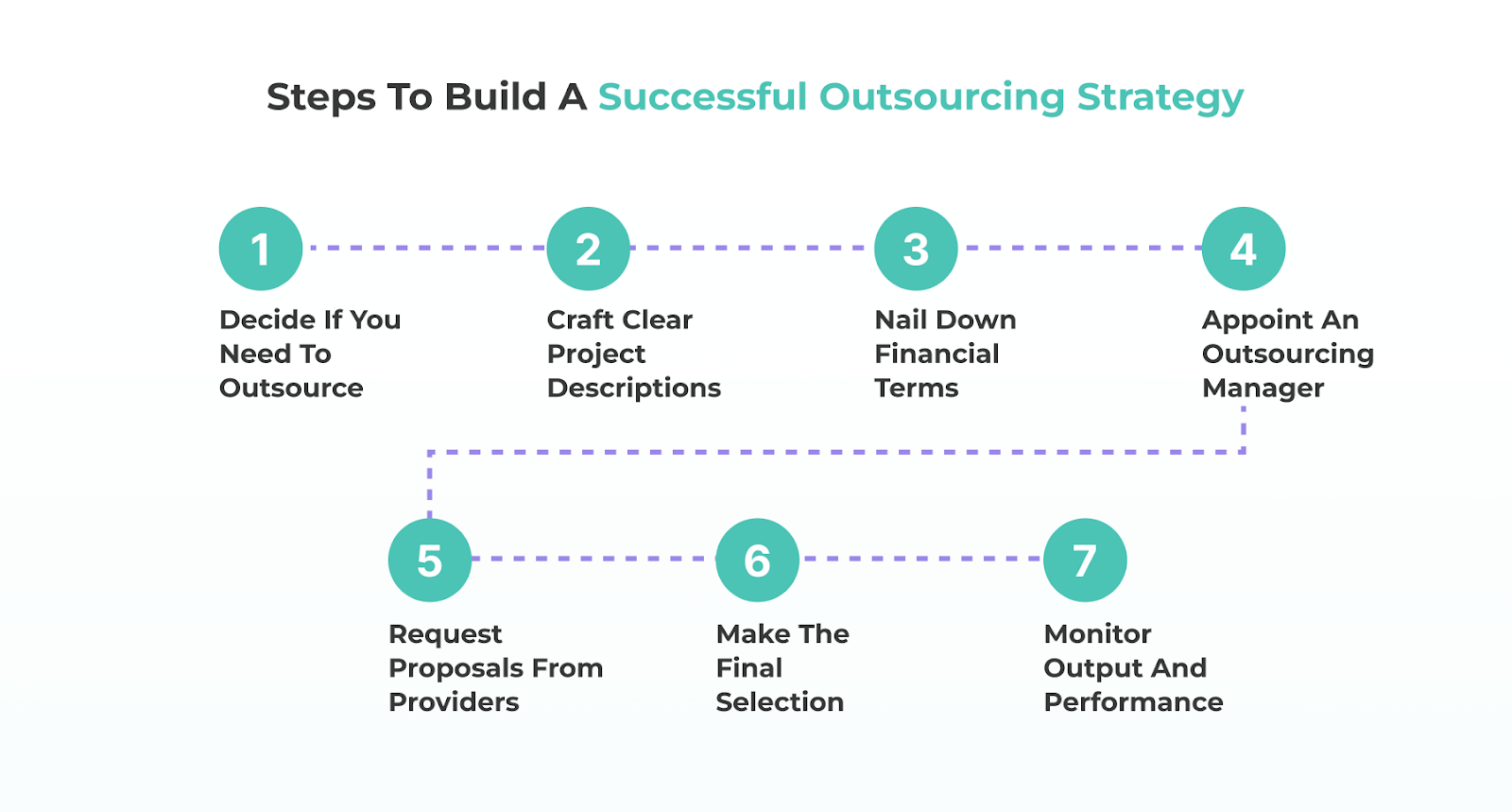
In today’s digital landscape, IT outsourcing has become a powerful strategy for businesses aiming to optimize resources, reduce costs, and access specialized expertise. However, simply outsourcing IT functions is not enough; businesses must follow a structured approach to ensure success. From evaluating the need for outsourcing to monitoring the performance of your external team, each step plays a critical role in maximizing the benefits of outsourcing.
Step 1: Decide If You Need to Outsource
Before jumping into outsourcing, businesses need to evaluate whether outsourcing IT functions is the right decision. The first consideration should be distinguishing between core and non-core activities. Core activities are those that define your business and provide a competitive advantage, while non-core activities, though essential, may not require in-house expertise. If an IT function is not critical to your business strategy but demands high operational costs or specialized skills, outsourcing can be a viable solution.
Cost versus benefit analysis is another crucial factor. Maintaining an in-house IT team comes with expenses such as salaries, infrastructure, training, and operational costs. Compare these expenses with the potential savings and efficiency gains that outsourcing offers. In many cases, outsourcing reduces costs while ensuring access to top-tier professionals with relevant expertise. However, cost should not be the only factor; the quality of service and long-term benefits should also be considered.
Scalability and flexibility are key advantages of outsourcing, but they should be assessed in the context of your business needs. Companies experiencing rapid growth or fluctuating IT demands can benefit from an outsourced team that can quickly adapt to changes. Additionally, outsourcing provides access to a wider talent pool, allowing businesses to leverage the latest technological advancements without the burden of constant recruitment and training. After evaluating these aspects, if outsourcing aligns with your business goals and offers a cost-effective, scalable solution, it is time to proceed with the next steps in the outsourcing process.
Step 2: Craft Clear Project Descriptions
A well-crafted project description is the foundation of a successful outsourcing partnership. Businesses must define the scope of work with absolute clarity, ensuring that expectations are aligned from the start. The first step is to establish precise objectives and deliverables. Clearly outlining the desired outcomes, success metrics, and key performance indicators (KPIs) helps prevent ambiguity and sets a measurable standard for evaluating the outsourced team’s performance.
Technology stack and infrastructure requirements should also be detailed to avoid any technical mismatches. Specifying programming languages, frameworks, software tools, and hosting environments ensures that the outsourcing partner is well-equipped to meet the project’s demands. A lack of technical clarity can lead to inefficiencies, rework, and misalignment between the business and service provider.
Timelines and milestone tracking play a crucial role in ensuring the project stays on schedule. Establishing phased deliverables with predefined deadlines helps monitor progress and mitigates the risk of delays. Incorporating a feedback loop at each stage allows for adjustments and course corrections, ensuring the final output meets business expectations.
Security and compliance are critical concerns, especially when outsourcing IT functions that involve handling sensitive data. Businesses should implement clear data protection policies, non-disclosure agreements (NDAs), and compliance measures that align with industry regulations such as GDPR, HIPAA, or ISO standards. By setting stringent security protocols from the outset, companies can safeguard confidential information while maintaining compliance with legal requirements.
A well-documented and transparent project description serves as a blueprint that minimizes risks, fosters seamless collaboration, and enhances the overall efficiency of the outsourcing process. By investing time in crafting a comprehensive project description, businesses lay a solid foundation for a successful outsourcing partnership.
Step 3: Nail Down Financial Terms
Financial planning is a critical aspect of outsourcing that directly impacts cost efficiency and the sustainability of the partnership. Establishing a well-defined financial structure helps businesses prevent budget overruns and ensures a mutually beneficial arrangement between both parties.
Choosing the right pricing model is the first step in financial planning. Businesses can opt for fixed-price contracts when project requirements are clear and well-defined, ensuring cost predictability. For projects requiring flexibility, an hourly or time-and-materials model may be more suitable, allowing adjustments based on evolving needs. In cases where ongoing development and maintenance are required, a dedicated team model provides continuous support with a stable cost structure. Selecting the right pricing strategy aligns financial commitments with business goals while maintaining cost-effectiveness.
Transparency in payment terms is crucial to avoid conflicts. Clearly defining milestones and linking them to payment schedules ensures that payments are made based on tangible progress. Businesses should negotiate terms that align with their cash flow and financial planning while ensuring timely compensation for the outsourcing provider.
A well-structured contract should also include clauses for additional costs, such as scope changes, revisions, or extra support. Defining service-level agreements (SLAs) with clear deliverables, deadlines, and quality benchmarks ensures accountability. Legal considerations, such as intellectual property rights, data security obligations, and termination clauses, should be outlined to protect both parties and prevent future disputes.
By establishing transparent financial terms, businesses can create a stable outsourcing relationship that balances cost control with high-quality service delivery, ensuring long-term success.
Step 4: Appoint an Outsourcing Manager
A dedicated outsourcing manager plays a pivotal role in bridging the gap between internal teams and external service providers. This position ensures seamless coordination, project alignment, and accountability, maximizing the effectiveness of the outsourcing partnership.
The outsourcing manager oversees project execution, ensuring that all tasks align with predefined objectives and timelines. By monitoring performance, tracking key milestones, and maintaining workflow efficiency, they help prevent project delays and quality issues. Strong communication is essential in outsourcing, and the manager acts as the main point of contact, facilitating smooth information exchange and conflict resolution.
Risk management is another critical responsibility of the outsourcing manager. Identifying potential challenges, such as security vulnerabilities, missed deadlines, or cultural differences, allows businesses to address issues proactively. Implementing contingency plans ensures operational continuity and minimizes disruptions.
Having a skilled outsourcing manager enhances collaboration, boosts efficiency, and helps businesses extract maximum value from their outsourcing investment. This role ensures that outsourcing aligns with strategic goals, delivering both cost savings and high-quality outcomes.
Step 5: Request Proposals from Providers
Once the project requirements and financial structure are in place, businesses should seek proposals from potential outsourcing providers. The selection process must focus on evaluating technical expertise, industry experience, and the ability to meet specific project demands.
Analyzing past work, case studies, and client testimonials provides insights into a provider’s reliability and performance. Businesses should assess whether the vendor’s technical stack aligns with the project requirements, ensuring seamless execution. Cultural compatibility and time zone alignment are also crucial factors that influence communication and collaboration efficiency.
Requesting comprehensive proposals that detail the provider’s approach, execution plan, and quality assurance measures allows businesses to compare options effectively. Vendors should present clear timelines, risk mitigation strategies, and pricing breakdowns, enabling informed decision-making.
Conducting thorough due diligence during this stage ensures the selection of a trusted, capable outsourcing partner who can deliver high-quality results while aligning with business expectations.
Step 6: Make the Final Selection
After shortlisting potential providers, businesses should conduct interviews and negotiations to determine the best fit. Trial projects can be an effective way to evaluate capabilities before committing to a long-term partnership. By assigning a small test project, businesses can assess the provider’s work quality, efficiency, and adherence to deadlines. Understanding the team composition is also crucial, ensuring clarity on who will be working on the project and their respective roles. Communication and reporting protocols must be established to maintain transparency and regular updates. This includes defining meeting schedules, reporting structures, and preferred communication channels. Once all factors are considered, finalizing a legally binding contract ensures that expectations, responsibilities, and protections are clearly documented. Choosing the right partner sets the foundation for a successful outsourcing relationship.
Step 7: Monitor Output and Performance
Outsourcing doesn’t end with hiring a vendor; continuous monitoring is essential to ensure success. Regular progress reviews should be conducted to discuss updates, address challenges, and maintain alignment with project goals. Performance metrics, such as project completion rates, defect rates, and response times, should be used to measure efficiency and quality. A strong feedback loop encourages open communication and allows businesses to provide constructive feedback, leading to ongoing improvements. Adaptability is another key aspect, as businesses should be ready to scale or modify the outsourcing arrangement based on performance and evolving business needs. If the partnership proves successful, exploring further collaboration opportunities can enhance long-term business growth.
Why Choose Teaser Software for Implementing IT Outsourcing?
Teaser Software is a trusted partner for businesses looking to leverage IT outsourcing for growth and efficiency. With a proven track record in delivering high-quality IT solutions, we provide tailored outsourcing services that align with your business objectives. Our team of skilled professionals specializes in software development, mobile applications, and website solutions, ensuring that your project is handled with expertise and precision.
One of the key advantages of choosing Teaser Software is our commitment to seamless communication and collaboration. We prioritize transparency, keeping you informed throughout every stage of the outsourcing process. Whether you need a dedicated development team, on-demand IT support, or strategic consulting, our flexible engagement models are designed to meet your specific needs.
Security and compliance are at the core of our outsourcing solutions. We implement strict data protection policies and adhere to industry standards, ensuring your business remains compliant with regulations such as GDPR and ISO standards. Our goal is to minimize risks while maximizing the efficiency and scalability of your IT operations.
With Teaser Software, you gain a reliable outsourcing partner who understands the evolving technology landscape and is dedicated to helping your business succeed.
Contact us today to explore how our outsourcing solutions can drive your business forward.
Starting a business is no easy feat, and for startups, managing costs while trying to grow and scale quickly can feel like walking a tightrope. Every dollar counts, and any inefficiency can make a huge difference in long-term sustainability. One area where many startups are turning to for cost-saving solutions is IT outsourcing. Outsourcing IT services has proven to be a strategic move that not only helps startups save money but also provides access to specialized expertise and scalable solutions.
What is IT Outsourcing?
Before diving into the specifics of how IT outsourcing can reduce costs, let’s first define what it is. IT outsourcing involves delegating specific IT functions and tasks—such as software development, technical support, cloud computing, and network management—to third-party service providers. Rather than hiring full-time, in-house staff to handle these tasks, startups can partner with external IT service providers who specialize in these areas.
IT outsourcing has grown in popularity due to its many benefits, including cost savings, access to global talent, and the ability to scale operations quickly. For startups, outsourcing IT functions allows them to leverage the latest technology and expertise without the overhead costs associated with managing an in-house team.
Key Ways IT Outsourcing Reduces Costs for Startups
Startups face a myriad of challenges, but one of the most significant hurdles is cost management. Fortunately, IT outsourcing can provide substantial cost-saving benefits across various areas. Let’s take a closer look at the specific ways outsourcing IT functions can help startups reduce their expenses.
1. Eliminates the Need for an In-House IT Team
One of the most significant financial burdens for any business is the cost of hiring and maintaining a full-time, in-house IT team. The expenses involved in recruiting, training, and compensating IT professionals can quickly add up. For startups that are still trying to establish themselves, this can be a substantial drain on resources.
By outsourcing IT services, startups can eliminate the need for hiring full-time employees dedicated solely to IT functions. Instead, they can rely on a third-party provider to handle IT operations. This reduces labor costs, including salaries, benefits, and other employee-related expenses. With IT outsourcing, you only pay for the services you need, and you’re not tied to long-term contracts or overhead costs like office space and equipment.
With an outsourced IT provider, startups can access high-quality support without having to manage a full-fledged in-house IT department. This flexibility allows startups to allocate resources more efficiently and focus on growing their core business.
2. Reduces Operational Expenses
Operational expenses are a major concern for startups, particularly in the early stages. Startups need to invest heavily in product development, marketing, and sales while managing day-to-day operations. Outsourcing IT functions can significantly reduce these operational costs.
For example, by outsourcing to a third-party IT provider, startups can avoid costly investments in IT infrastructure such as servers, software, and hardware. Instead, they can leverage cloud-based services and other cost-effective solutions offered by their outsourcing partner. These cloud solutions often come with pay-as-you-go models, which means startups only pay for what they use, eliminating the need to make large upfront investments.
Additionally, outsourcing companies typically provide maintenance and support as part of the service, reducing the cost of maintaining hardware and software on-site. This not only cuts costs but also ensures that startups are always using the latest technology without additional expenses.
3. Scalable Solutions for Growing Startups
Startups are dynamic, often requiring IT solutions that can scale as the business grows. Scaling operations internally can be costly and time-consuming, especially when it comes to IT infrastructure. Hiring new employees, expanding hardware, and upgrading software can require significant upfront investments.
IT outsourcing offers scalable solutions that allow startups to grow without incurring these heavy costs. As a startup expands, its IT needs will inevitably evolve, and outsourcing provides the flexibility to adjust resources quickly and efficiently. Whether it’s scaling up cloud storage, adding new software tools, or upgrading to more advanced technology, outsourcing ensures that startups only pay for the resources they need, when they need them.
This scalability also allows startups to avoid overcommitting to long-term IT investments that may not be necessary as the business fluctuates. The ability to scale operations up or down ensures that startups can adapt to changing business needs without financial strain.
4. Access to Expertise Without the High Price Tag
Another cost-saving advantage of IT outsourcing is the access to specialized expertise. Building an in-house IT team with the necessary skills and experience can be expensive, especially for startups operating with limited budgets. Finding qualified IT professionals, particularly those with expertise in areas such as cybersecurity, software development, and data analytics, can be challenging and costly.
By outsourcing IT functions, startups gain access to a wide range of highly skilled professionals at a fraction of the cost of hiring full-time employees. Outsourcing providers typically employ specialists in various fields, allowing startups to tap into this expertise without the need for expensive recruitment or training. This also means that startups are less likely to face costly mistakes or inefficiencies due to a lack of experience in complex IT tasks.
Moreover, because IT outsourcing companies work with multiple clients, they often have access to cutting-edge technology and tools that would be out of reach for startups on their own. This allows startups to benefit from innovation without having to make hefty investments in new technologies.
5. Focus on Core Business Activities
For a startup, focusing on core business activities is essential for growth and success. Managing IT operations in-house can take up valuable time and resources that could be better spent on product development, sales, marketing, and customer acquisition. IT outsourcing helps alleviate this burden by allowing startups to focus on what they do best while leaving the IT complexities to external experts.
With IT outsourcing, startup founders and teams no longer need to worry about handling IT tasks themselves or dealing with issues like server outages or software bugs. They can focus on innovation, expanding their customer base, and refining their products, all while knowing that their IT infrastructure is in the hands of reliable professionals.
This shift in focus not only helps reduce stress but also promotes business growth. Startups that outsource IT services can remain agile and responsive to market changes, all while leveraging IT solutions that support their long-term vision.
Benefits Beyond Cost Reduction
While cost savings are a major reason for outsourcing IT services, there are additional advantages that can help startups thrive in a competitive market. Let’s take a look at some of the other benefits of IT outsourcing.
1. Faster Time-to-Market
In today’s fast-paced business environment, time-to-market can make or break a startup. The ability to bring a product or service to market quickly is essential for gaining a competitive edge. IT outsourcing can significantly accelerate development cycles by providing startups with access to skilled teams who can handle IT tasks more efficiently.
Whether it’s speeding up software development, managing infrastructure, or implementing new systems, outsourcing allows startups to focus on innovation while experienced IT professionals handle the technical side. This helps reduce delays, improve efficiency, and ensure that the product reaches the market on time.
2. Flexibility and Innovation
Outsourcing IT functions gives startups access to flexible solutions that can evolve with their needs. Whether it’s adopting new technologies or exploring innovative approaches to IT management, outsourcing providers can offer solutions that keep startups on the cutting edge without the high upfront costs.
Startups can also explore new opportunities for growth by leveraging the expertise of outsourced IT teams. For instance, if a startup wants to experiment with artificial intelligence or machine learning, they can easily collaborate with outsourcing providers who have expertise in these fields, without needing to hire full-time employees.
This ability to innovate quickly and adapt to changing market conditions is crucial for startups seeking to stay ahead of the competition.
How to Choose the Right IT Outsourcing Partner?
Choosing the right IT outsourcing partner is essential to ensure that you’re getting the most value for your investment. Here are a few factors to consider:
Expertise: Look for an outsourcing partner with proven experience in the specific IT services your startup needs. They should have a track record of delivering high-quality solutions and keeping up with industry trends.
Communication: Effective communication is key to a successful outsourcing relationship. Ensure that the provider has clear communication channels and is responsive to your needs.
Cost-effectiveness: While cost savings are important, make sure that you’re not sacrificing quality for the sake of a cheaper option. Look for a provider that offers competitive pricing while maintaining high standards.
In conclusion, IT outsourcing offers startups a powerful way to reduce costs and access high-quality expertise without the overhead of building an in-house IT team. By outsourcing IT functions, startups can eliminate the need for a full-time IT staff, reduce operational expenses, scale resources as needed, and gain access to cutting-edge technology. Additionally, outsourcing allows startups to focus on their core business activities, driving innovation and growth.
If you’re a startup looking to reduce costs and increase efficiency, IT outsourcing may be the strategic solution you need.
Among the leading players in the outsourcing services field, Teaser stands out as a trusted partner. With a wealth of experience and in-depth knowledge across various industries, Teaser helps businesses meet their strategic objectives. When you consult Teaser, you gain access to a wide range of industry-specific IT services, including IT support, software development, and customer relations management.
Partner with Teaser to outsource your needs and take your business to the next level of operational efficiency, ensuring you meet your goals and objectives.